

A New Revolution Has Begun
By Kirtan Bhana – TDS
25 March 2026
The late twentieth century witnessed a decisive turning point in global history at the Battle of Cuito Cuanavale. Fought on Angolan soil between 1987 and 1988, this confrontation was a regional military engagement that led to geopolitical rupture. The victory of revolutionary forces, supported by Cuban internationalists and aligned liberation movements, dealt a strategic blow to apartheid South Africa’s military ambitions and hastened the independence of Namibia. More profoundly, it accelerated the internal and external pressures that would eventually dismantle apartheid in South Africa.
This historic moment unfolded in parallel with the disintegration of the Cold War order, symbolised by the Fall of the Berlin Wall and the collapse of the Soviet Union. Together, these events reshaped global power structures, ushering in a unipolar world that promised liberal democracy, free markets and global integration. Yet, as history has shown, that promise was unevenly fulfilled.
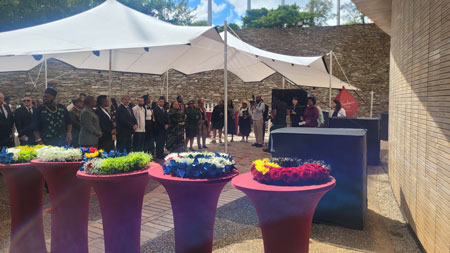
Nearly four decades later, the annual commemoration at Freedom Park is an act of remembrance and becoming a site of reflection and redefinition. What emerges from these commemorations is a growing recognition that the post-Cold War order, much like the colonial systems before it, has reached a point of exhaustion. The world now stands on the threshold of another transformation, a new revolution, not of trenches and tanks, but of technology, information and consciousness.
From Liberation Struggles to Systemic Reimagining
The revolution symbolised by Cuito Cuanavale was rooted in physical struggle—territory, sovereignty and political self-determination. Today’s revolution operates on a different terrain. It is systemic rather than territorial, digital rather than industrial, and global rather than regional.
The post-colonial and post-Cold War systems have increasingly revealed deep contradictions. Economic inequality persists despite unprecedented global wealth. Political systems, while formally democratic, often suffer from declining trust and legitimacy. International institutions struggle with accusations of bias, selective enforcement and double standards. In many ways, the old order has become mired in the very injustices it once claimed to overcome.
The emerging revolution seeks to address these contradictions through structural transformation.
At the heart of this new revolution lies the technological epoch. The rise of artificial intelligence, blockchain systems and digital connectivity has fundamentally altered the architecture of power. Information is no longer monopolised by states or institutions; it flows across borders in real time, empowering individuals and decentralised networks.
Economically, this shift is redefining value creation. Traditional industries are being disrupted by digital platforms, while new forms of economic participation—such as the gig economy, digital currencies and decentralised finance—are challenging established financial systems. For countries in the Global South, this presents both an opportunity and a risk: the chance to leapfrog stages of development, but also the danger of new forms of digital dependency.
Socially, the revolution is reshaping identity and community. Digital platforms have created a global public sphere where narratives are contested, solidarities are formed, and injustices are exposed. Movements that once took years to build can now mobilise in days. The legacy of liberation struggles, including those connected to Cuito Cuanavale, finds new expression in digital activism and transnational networks.
If the twentieth century was defined by control over territory and resources, the twenty-first century is defined by control over information. The democratisation of communication has disrupted traditional hierarchies, but it has also introduced new challenges: misinformation, surveillance and the weaponisation of data.
In this context, information becomes both a tool of liberation and a site of contestation. The ability to shape narratives—to define what is true, just and legitimate—has become a central battleground of the new revolution. This is particularly significant for Africa, where historical narratives have often been shaped by external perspectives. The digital age offers an opportunity to reclaim and redefine these narratives on African terms.
Toward a More Just Global Order
The new revolution is, at its core, a search for a more equitable and inclusive global system. It calls for a rebalancing of power, between North and South, state and citizen, capital and labour. It challenges the legitimacy of systems that perpetuate inequality and demands accountability in governance, both domestic and international.
In this sense, the spirit of Cuito Cuanavale endures. The battle was not only about military victory; it was about dignity, sovereignty, and the right to shape one’s own destiny. These principles remain central to the current transformation, even as the tools and arenas of struggle have changed.
History does not move in straight lines; it unfolds in cycles of rupture and renewal. The Battle of Cuito Cuanavale marked the end of one era and the beginning of another. Today, as the world grapples with the complexities of the digital age, we may be witnessing a similar inflection point.
The new revolution is quieter but no less profound. It is driven not by armies, but by ideas, not by territorial conquest, but by technological innovation and social transformation. Yet, like the struggles of the past, it is ultimately about justice, about creating a world that is fairer, more inclusive, and more reflective of our shared humanity.
As commemorations continue at Freedom Park, they serve as a reminder that revolutions do not end, they evolve. And in that evolution lies both the challenge and the promise of our time.