

Hong Kong–Gauteng emerging new safe havens in a fragmented global economy
Kirtan Bhana - TDS

25 March 2026
In an era defined by geopolitical volatility, supply chain disruptions and shifting centres of economic gravity, a new narrative of strategic opportunity is emerging. The growing cooperation between Hong Kong and Gauteng (Place of Gold) signals the rise of two interconnected regional hubs that are positioning themselves as “safe havens” for investment, innovation and stability across Asia and Africa.
The Shenzhen–Hong Kong–Johannesburg Economic Trade Cooperation Conference, held in Johannesburg on 20 March, brought together influential policymakers, institutional leaders and business stakeholders whose insights collectively framed a new phase of Afro-Asian cooperation. At the heart of this partnership lies a powerful alignment of capabilities and a convergence of strategic hubs. Shenzhen, widely regarded as China’s innovation engine, and Hong Kong, a globally trusted financial and legal gateway, form the eastern pivot of this cooperation. On the African side, Johannesburg—located in Gauteng, South Africa’s economic powerhouse, serves as the continent’s primary financial and commercial gateway. Together, these regions form a dynamic corridor linking the Guangdong–Hong Kong–Macao Greater Bay Area (GBA) with Africa’s most industrialised province.
Leadership Driving the Vision
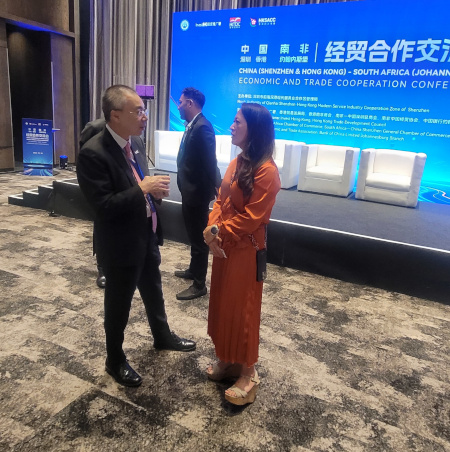
The depth and seriousness of this engagement were reflected in the calibre of the participants who articulated both the strategic vision and practical pathways forward.
Wang Shourui, Secretary of the Qianhai Cooperation Zone Work Committee, provided a comprehensive overview of the Greater Bay Area, emphasising its role as China’s premier high-growth region and a model for integrated development.
Zhang Junjie, Director of the Qianhai Investment Promotion and Enterprise Service Center, highlighted the unique role of the Qianhai Cooperation Zone as a bridge between Shenzhen’s technological innovation and Hong Kong’s financial services, positioning it as a critical access point for international partners.
From Hong Kong, King Chung Lam, Deputy Head of International Markets, Consulates and Chambers at Invest Hong Kong, elaborated on the enduring strengths of Hong Kong under the “One Country, Two Systems” framework, highlighting its reliability as a global financial hub.
Representing the business community, Angela Yeung of the Hong Kong South Africa Chamber of Commerce described the engagement as a pivotal moment—a transition from dialogue to delivery. She emphasised that the real value of such platforms lies in partnerships formed, investments unlocked and businesses successfully entering new markets.
At the diplomatic level, Pan Qingjiang, Consul General of the People’s Republic of China in Johannesburg, situated the cooperation within China’s broader development trajectory. Referencing the outcomes of the Two Sessions, he highlighted China’s commitment to high-quality development, technological innovation, and global openness.
Safe Havens in a Time of Uncertainty
The concept of “safe haven” in today’s geopolitical landscape extends beyond traditional notions of neutrality or low risk. It now encompasses stability of governance, predictability of regulation, access to capital, and integration into global value chains.
Hong Kong’s robust legal and financial systems continue to provide certainty for global investors, while Gauteng offers a stable and sophisticated gateway into Africa. Johannesburg’s legacy as “Egoli”—the City of Gold—remains symbolic of its enduring economic influence.
In this evolving context, the Hong Kong–Gauteng partnership emerges as a dual-anchor system—linking capital, innovation, and markets across continents.
A key outcome of the conference was a clear shift from opportunity to execution toward action-oriented collaboration. The opportunities identified are immediate and tangible. South African exports, from agriculture to precious metals, are increasingly in demand in Asian markets, while Hong Kong provides a strategic platform for capital raising and entry into the Greater Bay Area.
At the same time, Chinese and Hong Kong enterprises are looking toward South Africa as a gateway into broader African markets, leveraging its infrastructure and regional integration.
China’s forthcoming zero-tariff policy for African countries from May 2026 further strengthens this outlook, creating new momentum for trade and investment flows.
A New Afro-Asian Growth Corridor
The convergence of Hong Kong and Gauteng represents economic cooperation reflecting a reconfiguration of global partnerships. Anchored by visionary leadership and supported by institutional frameworks, this partnership is poised to deliver stability, innovation, and inclusive growth.
As highlighted by the speakers, the foundation has been laid. The next phase will be defined by execution, transforming strategic alignment into measurable outcomes.
In positioning themselves as safe havens, Hong Kong and Gauteng are not only responding to global uncertainty. they are shaping a new paradigm of Afro-Asian cooperation, one defined by resilience, connectivity and shared prosperity.